
November is AI Literacy Month, and the founding list is still open
Oct 2, 2026
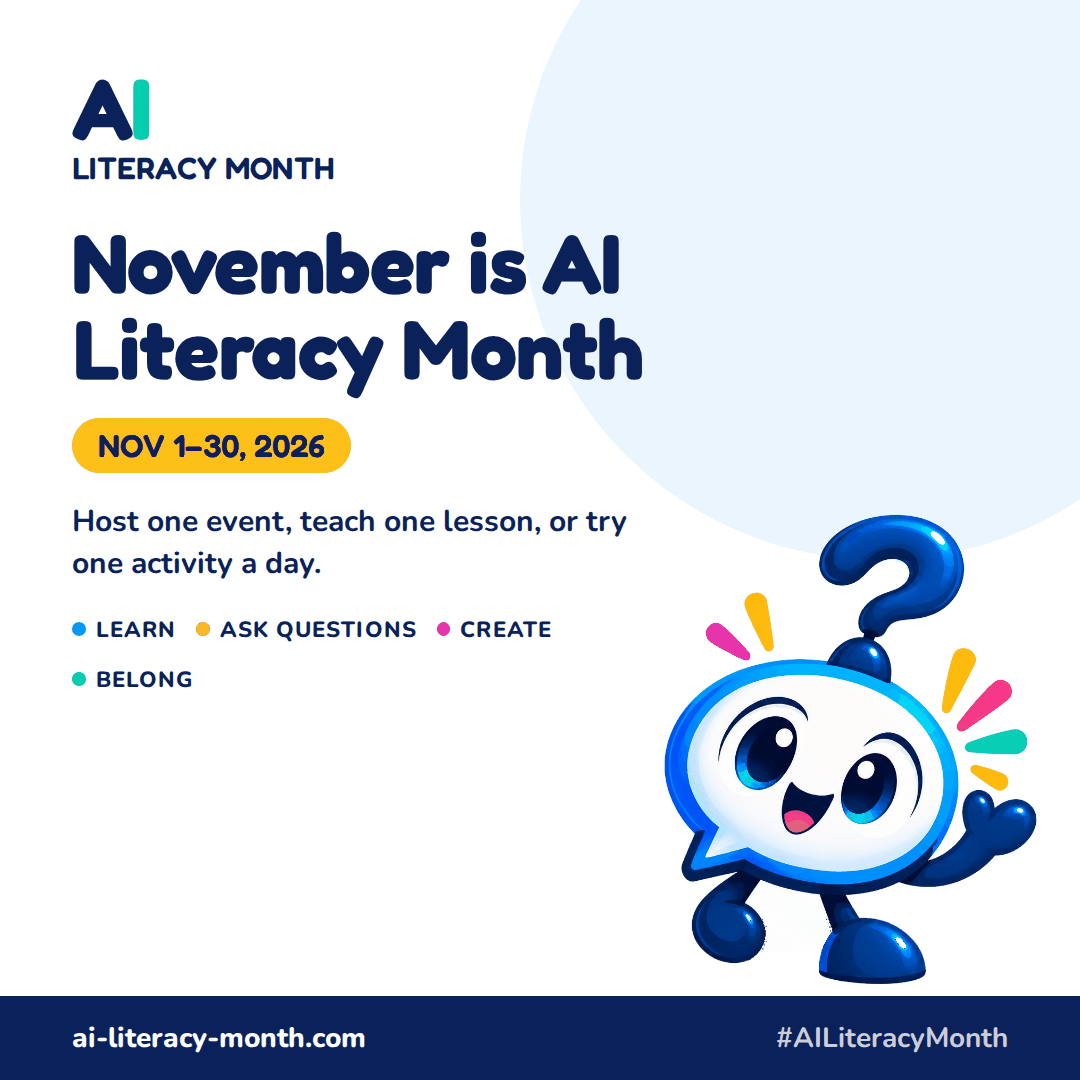
AI Literacy Month runs November 1–30, 2026. It is a grassroots effort — no budget, no membership fee, no committee to join — and the bar to take part is deliberately low: one event and a date. Colleges, K–12 schools and districts, public libraries, cities and counties, chambers of commerce, small businesses, nonprofits and public agencies are all invited, and the founding participant list is still open.
If you have been waiting for a reason to do something about AI literacy on your campus or in your town, this is a ready-made one, and someone else has already built the materials.
Why November
November 30, 2022 is the day ChatGPT launched publicly. Whatever you think of what followed, that date is when generative AI stopped being a research topic and became a public one. AI Literacy Month uses that anniversary as an invitation to widen the conversation past any single company or tool.
The placement in the calendar does real work. October is Cybersecurity Awareness Month, which teaches communities to protect themselves. November picks up where that leaves off: protect yourself, then empower yourself. And it hands off again in December to the Hour of AI during Computer Science Education Week. It is also designed as a fall companion to National AI Literacy Day each spring, not a competitor to it.
The invitation: Learn, Ask Questions, Create, Belong
Four ways in, and a community can start with just one:
- Learn — understand what AI actually is, how it works, and where it already shows up in a classroom, a job, a city department.
- Ask Questions — bias, privacy, accuracy, authorship, accountability. Curiosity and skepticism belong together.
- Create — literacy becomes real the moment somebody makes something with it.
- Belong — nobody should be left out of this shift, and plenty of people currently are.
The movement’s mascot is a speech bubble named Curio, whose antenna is a question mark rather than an exclamation point. He is deliberately not a robot. The point of him, in the organizers’ words, is that a speech bubble is empty until somebody speaks.
What it would actually take from you
The honest answer is: less than you think, and the organizers have been direct about this. Five steps, and the first one is an email.
- Claim your month. Tell them your campus, district, library, chamber or city is taking part. That is enough to be counted as a founding participant.
- Pick one event. A single workshop, a lunch panel, one classroom lesson, a student showcase. One event is a complete first year.
- Download the toolkit instead of building materials from scratch.
- Request a proclamation from your city council, board of trustees or district.
- Share what happened, so the next community can borrow what worked.
The toolkit is free and there is no email wall
Thirteen resources are downloadable right now without signing up for anything: an editable proclamation template, a fill-in-the-blank press release, three ready-to-send emails, a printable 30-day calendar, an AI literacy pledge, an event flyer template, a small business AI checklist, a 90-minute civic roundtable facilitation guide, a full activity pack, a one-page case you can forward to a dean or a city clerk, an editable 45-minute workshop deck, and social graphics in English and Spanish.
There is also a 30 Days of AI Literacy campaign — a daily theme with a 15-minute activity, a prompt and discussion questions, running from “What Is AI?” on November 1 through Capstone Day on November 30. A library could post one a day and have a month of programming without writing anything. And there is a curated list of 26 genuinely free courses, several with certificates or badges, sorted by audience: everyone, college students, faculty, K–12 teachers and families, small business and workforce, and Spanish-language options.
What each kind of organization could do
Colleges: faculty AI workshops, a student AI showcase, a prompt-a-thon, an AI ethics panel, or a career readiness session with your workforce office. If you are a California community college, this was built with the system in mind — it grew out of the Chancellor’s Office AI Fellows Program, and the first imagined scale was all 116 colleges.
K–12 schools and districts: a parent AI literacy night is the single highest-value event on the list and almost nobody is running one. Add a student creativity challenge or a lesson on AI safety and misinformation.
Libraries: you are the most natural host in this entire movement. A drop-in AI help session, an older-adults class — the course list includes a free AARP Senior Planet program built for adults 50+ — or one of the daily activities as a standing weekly hour.
Cities and counties: a proclamation costs nothing and signals a great deal. There is a ready-to-edit template with the whereas clauses already written. Pair it with a civic AI forum or a responsible-use policy conversation.
Chambers and small businesses: an AI for small business workshop, a marketing clinic, or a roundtable where local owners compare what has actually worked. Small businesses are adopting these tools with almost no support, and a chamber is well positioned to fix that locally.
Nonprofits and public agencies: there is a dedicated day for AI in government and another for nonprofits in the 30-day calendar, and both come with a starting activity.
A note for vendors
Companies that sell into education — and particularly those doing business with California community colleges — are welcome here, with a condition worth stating plainly: this is not a marketing channel. The useful contribution from a vendor is teaching something, funding something, or giving something away: sponsoring a student event, running a genuinely product-neutral workshop, donating seats or licenses to a college that cannot afford them, or underwriting printing for a district.
The movement’s own course list is a decent model of the standard — it includes free offerings from Anthropic, Microsoft, Google, IBM, OpenAI Academy and others, with a note at the bottom stating that listing a course is not an endorsement of any company. Help a community learn, and the goodwill takes care of itself.
The commitments underneath it
The movement publishes six guiding commitments: AI should be human-centered, useful, mindful, accountable, navigable, and student- and society-serving.
These are deliberately positioned as a companion to the California Community Colleges Chancellor’s Office H.U.M.A.N.S. framework rather than a replacement for it. H.U.M.A.N.S. governs how institutions adopt AI. The six commitments put the same concerns — privacy, equity, transparency, human judgment — into language a small business owner, a parent or a city council member can act on. Colleges should follow H.U.M.A.N.S.; everyone should be able to follow these.
Where it stands right now
Early, and openly so. At the time of writing, one event is posted on the public calendar: Fullerton College’s AI Challenge Day, a hybrid session in the library on Wednesday, November 18. The founding supporters section of the site is mostly reserved space.
That is the opportunity rather than the problem. Founding participant is a status that exists exactly once, and there are still about four weeks before November 1 — enough time to book a room, pick a date, and get a proclamation onto a council agenda. A single workshop in a library in a town of four thousand counts the same as a campus-wide week.
AI Literacy Month was created and is organized by Professor Gary Graves of Fullerton College, a California Community Colleges Chancellor’s Office AI Fellow. Full disclosure, since this is his site: EDUAIATLAS is listed as a Founding Resource Partner.
How to join
Everything — the toolkit, the 30-day calendar, the free course list, the proclamation center, the brand kit, the event submission form and the sign-up — is at ai-literacy-month.com. Or simply email ggraves@fullcoll.edu and say your organization is in. Hosting something? Add it to the public calendar so other communities can see it. Share what you run with #AILiteracyMonth.
One event. One date. That is the whole ask.